
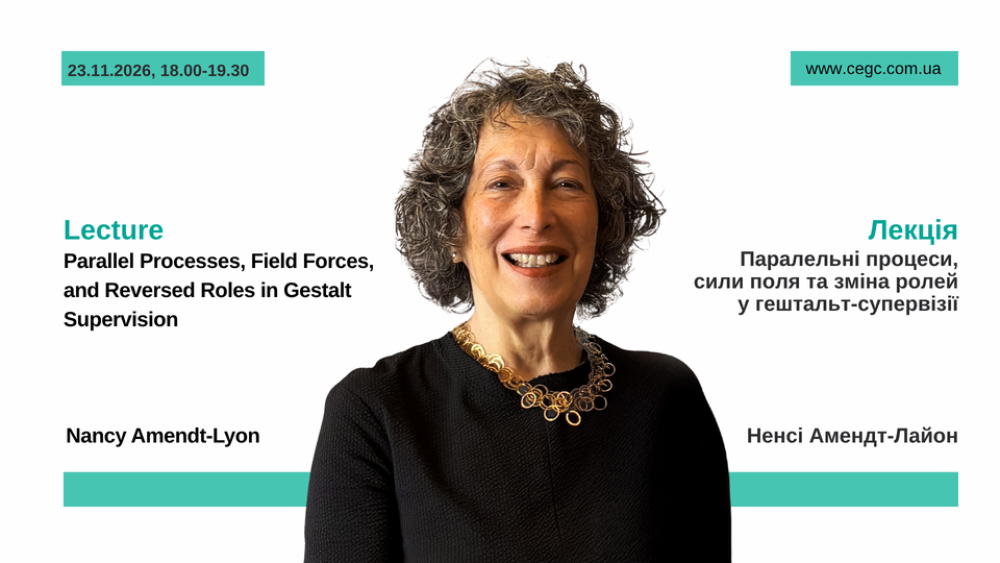
Parallel Processes, Field Forces, and Reversed Roles in Gestalt Supervision
Supervision. Field. Contact.
Format
November 23, 18:00–19:30
Online
English with translation
Fee
1500 UAH
FACILITATOR:
Nancy Amendt-Lyon, Dr. phil., M.A. is a Gestalt therapist, supervisor, and trainer. Born in New York, she studied psychology in the United States, Switzerland, and Austria. Since 1978, she has maintained a private practice in Vienna, working in English and German with individuals, couples, and groups.
From 2007 to 2021, she served as President of the Austrian Association for Gestalt Therapy (ÖVG). She is a full member of the New York Institute for Gestalt Therapy, a member of EAGT, and an external trainer at the Czech training institute Gestalt Studia. She has extensive experience training Gestalt therapists, group analysts, and supervisors in Austria and internationally.
Her publications include numerous articles and book chapters on Gestalt therapy, gender, and socially relevant issues. She is also an author and editor of several professional publications, including co-editor of Creative License: The Art of Gestalt Therapy and editor of Timeless Experience: Laura Perls’s Unpublished Notebooks and Literary Texts 1946–1985. She is also a member of the editorial board of Gestalt Review.
Supervision is not only a conversation about the therapist’s work with the client.
Within the supervisory process itself, phenomena may emerge that help us see more clearly what is happening in the therapeutic situation.
Nancy Amendt-Lyon explores supervision through three interconnected concepts:
parallel processes, field forces, and reversed roles.
In her supervisory practice, she applies these concepts in individual, group, and team supervision. Her approach has developed over decades of practice and is connected with the development of her own professional style and a willingness to experiment.
During the lecture, Nancy will explore how these concepts unfold directly within the supervisory process.
We will focus on:
— parallel processes and their place in supervision;
— field forces that influence the supervisory process;
— shifts in roles between participants;
— the development of the supervisor’s personal style;
— the possibility of experimenting in supervisory practice;
— working with group supervision;
— the importance of ongoing supervision for professional development and effectiveness.
This meeting is for those who want to explore supervision not only as a space for analyzing professional work, but also as a living process of interaction in which the supervisory contact itself becomes part of professional inquiry.